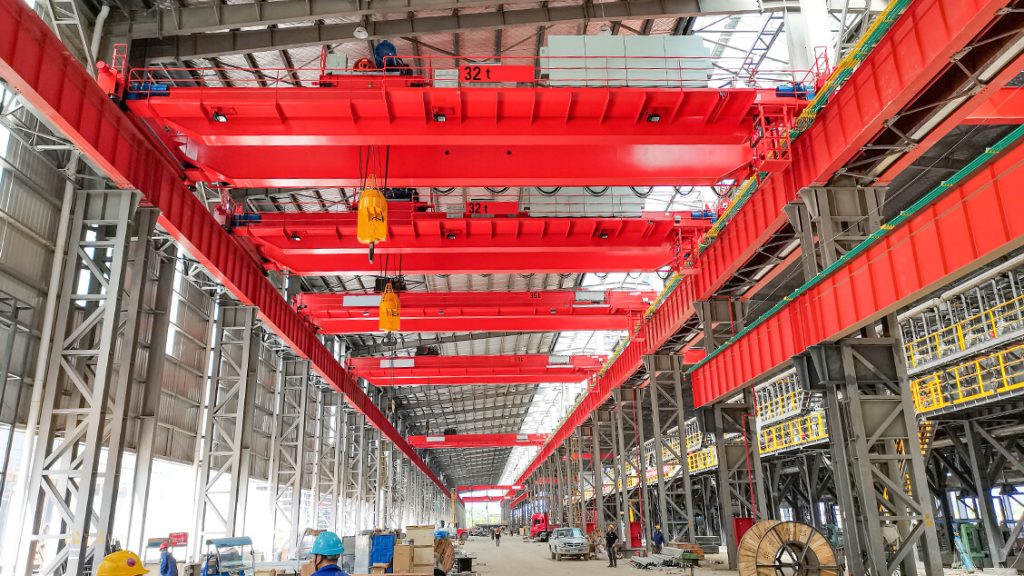
Crane Solutions for Manufacturing Plants
Custom overhead, gantry and workstation crane systems designed to improve material handling efficiency, reduce downtime and support safe production in manufacturing facilities.
40 Years Manufacturing Experience
Exporting to 60+ Countries
Material Handling Challenges in Manufacturing Plants
Limited Floor Space
Inefficient Material Flow
Heavy or Irregular Loads
Manufacturing plants often need to move heavy machines, steel parts, molds, components or assembled structures.
Downtime and Safety Risks
How Guanhui Builds the Right Crane Solution for Your Plant
Layout-Based Crane Design
We design crane systems based on your workshop layout, span, lifting height, production flow and load characteristics.
Strict QC & Whole Crane Trial Assembly
From NDT weld checks to in-factory whole crane trial assembly, we enforce strict QC to guarantee zero-defect alignment and stable long-term operation.
Installation & Technical Support
We provide installation guidance, technical documentation and commissioning support for overseas manufacturing projects.
Crane Systems for Different Manufacturing Needs
Overhead Cranes
Ideal for indoor manufacturing workshops where heavy materials need to move efficiently across production areas.
Gantry Cranes
Suitable for outdoor yards, large components, steel storage areas and semi-open manufacturing sites.
Workstation Crane Systems
Flexible light-duty lifting systems for workstations, assembly lines and frequent small-load handling.
KBK Light Crane System
The KBK Light Crane System by Guanhui offers an unparalleled solution for ergonomic handling, precise positioning, and seamless overhead transport.
Manufacturing Plant Applications
Steel Coil Handling
For lifting and transferring steel coils, plates and heavy metal materials across production and storage areas.
Machinery & Equipment Assembly
Metal Processing Workshop
Warehouse & Production Logistics
Not Sure Which Crane Fits Your Manufacturing Plant?
| Requirement | Recommended Solution |
|---|---|
| Indoor heavy material handling | Overhead Crane |
| Outdoor or semi-open yard lifting | Gantry Crane |
| Assembly line light-duty lifting | Workstation Crane |
| Complete crane project support | Components & Runway System |
Custom Crane System for Manufacturing Workshop
Guanhui provides customized crane systems for manufacturing plants where production efficiency, lifting safety and long-term reliability are critical. Our engineering team designs each crane solution based on workshop layout, load characteristics, working duty and installation conditions.
✓ Layout-Based Custom Design
✓ Stable Heavy-Duty Operation
✓ Reliable Components & Control System
✓Strict NDT Inspection & Pre-Shipment Whole Crane Trial Testing
✓ Installation and Commissioning Support
Direct Crane Manufacturer for Industrial Projects
Guanhui Crane is a professional crane manufacturer with nearly 40 years of experience in crane design, manufacturing, installation and export. We support overseas manufacturing plants with customized lifting solutions, strict quality control and engineering support.
Custom Crane Engineering
100% NDT & Whole Crane Trial Testing
Request a Custom Manufacturing Plant Crane Solution
Frequently Asked Questions
The best solution depends on the load, required movement, operating frequency, production process and available building space. An overhead bridge crane can provide wide workshop coverage, while a gantry crane may be suitable where an independent supporting structure is required.
Jib cranes and workstation cranes support localized lifting, and monorail systems are effective for repetitive movement along a defined route. Many plants use a combination of crane types to connect receiving, production, assembly, maintenance and storage areas.
Yes. The crane can be configured around the building height, column spacing, production equipment, aisles, utilities and required hook approaches. Depending on the site, the solution may use a top-running or under-running crane, a low-headroom hoist, a freestanding runway or a localized workstation system.
For an existing building, the runway geometry, clearances and supporting structure should be verified before the design is finalized. We provide the crane loads and interface requirements, while the building capacity should be confirmed by a qualified structural engineer.
Please provide lifting capacity, span, lifting height, workshop layout, load type, working duty, power supply and project location. If you have drawings or layout plans, you can upload them with your inquiry.
Rated capacity alone does not determine whether a crane is suitable for a manufacturing process. Duty class reflects operating frequency and intensity, while the load spectrum describes how often the crane handles light, average and maximum loads.
A crane used occasionally for maintenance should not be specified in the same way as a production crane operating repeatedly across multiple shifts. Correct duty selection helps match the structure, hoist, motors, brakes and controls to the actual workload, reducing the risk of premature wear or unnecessary overspecification.
Reliability begins with selecting the correct crane type, duty class, components and environmental protection for the actual operating conditions. Maintainable component layouts, accessible service points and recommended spare parts can also help make routine maintenance more efficient.
Regular inspections and preventive maintenance help identify wear before it develops into a larger operational problem. For production-critical cranes, maintenance planning should be aligned with plant shutdown schedules and parts availability.
The additional investment should deliver measurable value where it matters most: keeping production moving, handling valuable loads safely and accurately, reducing maintenance disruption, and providing dependable technical and spare-parts support. The crane should also be engineered for the plant’s actual duty cycle, production layout and operating conditions—not simply selected by lifting capacity.
The right comparison is not the purchase price alone. It is the total cost of unplanned downtime, damaged materials, components or tooling, production delays, maintenance, energy use and equipment ownership over the crane’s working life.